
I have to admit, I kind of wish the lamp on my desk
contained an awesome blue dude who could sing, dance, and, ya know, turn me
into a pseudo-prince with an awesome elephant so I could win the heart of the
girl of my dreams. Am I shooting to
high?
Aladdin was one of my all-time favorites growing up. It was definitely my favorite at one point,
and in the end probably only was surpassed by The Lion King II, and today
Aladdin has reclaimed first place in my heart (not that I think it’s perfect;
we’ll get to that in a second).
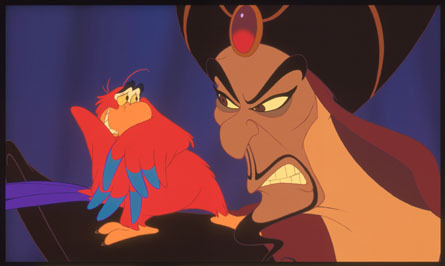 The driving force of the plot itself is Jafar and his
over-talkative parrot Iago. Jafar, the
Saltan’s advisor, has
The driving force of the plot itself is Jafar and his
over-talkative parrot Iago. Jafar, the
Saltan’s advisor, has
Thankfully, Aladdin figures out the lamp and
tricks the eccentric genie into getting him out voluntarily (who then
reprimands him, saying “No more freebies”).
Through a long series of events, Jafar schemes to get Jasmine to marry
him, who is horrified and refuses. Jafar
eventually gets his hands on the lamp and turns the kingdom into a living
nightmare and with his magic (Jafar being a sorcerer himself) sends Aladdin far
away. Aladdin, undeterred, walks back
and defeats Jafar, and they all live happily ever after.
Before I start in on a heavy criticism of the film’s finer
details, I want to spend some time talking about Aladdin and Jasmine’s story.
When Aladdin and Jasmine meet, Aladdin saves her life (or at
least her hand). He subsequently shows
her around and the two are quickly falling for each other when the palace
guards swing in and take her back and throw Aladdin in prison under the guise
of kidnapping. When he gets back out
with the help of the genie and marches into town as a prince, Jasmine, not
knowing that he is the same man, is less than enthusiastic. But, through his persistent efforts, and the
help of a magic carpet, he is able to win her heart once again, and through a
lot more work than the first time through.
So, that covers the plot.
Now comes the criticism. I did
say that this film was one of my favorites.
That does not mean, however, that it gets any special treatment. There are a few problems with the film.
 First, there is a moral conundrum: how immoral is stealing,
really? Aladdin is portrayed as an
abused unfortunate homeless boy, while the vendors that he is stealing from are
portrayed as stringent, selfish mongrels with an overabundance of product and
no room in their hearts for pity. No one
stops to ask “What about the vendors?” because Aladdin is the victim and they
are the abusers. I might feel
differently about this point if Aladdin were remorseful for his stealing, or
even admitted that it was a necessary evil for him to survive; but instead, he
and Abu make a sport out of it.
First, there is a moral conundrum: how immoral is stealing,
really? Aladdin is portrayed as an
abused unfortunate homeless boy, while the vendors that he is stealing from are
portrayed as stringent, selfish mongrels with an overabundance of product and
no room in their hearts for pity. No one
stops to ask “What about the vendors?” because Aladdin is the victim and they
are the abusers. I might feel
differently about this point if Aladdin were remorseful for his stealing, or
even admitted that it was a necessary evil for him to survive; but instead, he
and Abu make a sport out of it.
Secondly, the portrayal of Jasmine’s father, the unnamed
Saltan, is beyond horrifying. Instead of
the father figure being a strong leader, protector, and guardian of his
daughter and of the country, he is a weak pushover whose very demeanor is about
as masculine as a tutu. In contrast,
Jasmine is strong, independent, and ambitious.
I don’t have a problem with Jasmine’s character. What I do have a problem with is her father
and her in comparison. Between the two,
it is Jasmine who possesses the masculine characteristics. We have enough gender confusion in our
society as is, we don’t need effeminate fathers contributing to it.
My third negative is not so much a criticism of Aladdin
itself as it is a criticism of the portrayal of love in film in general, but I
believe it to be a valid criticism nonetheless.
When Aladdin is telling the genie why he loves Jasmine, what comes out
are not descriptions of her character, but rather her appearance. Her hair.
Her smile. You get the idea. This feeds into a monstrosity ideology that
women are to be loved not for who they are but for what they look like. Don’t get me wrong, I will swear on my very
life that women got the looks between the two sexes. No argument there. But reducing women to that as being their
primary source of value is chauvinistic and degrading. Truth be told, I love Aladdin and Jasmine as
a couple. I just despise his reasons for
pursuing her to begin with.
With all of that said, the film is definitely not without
its positive points. The crux of the
film really comes from Aladdin’s insecurity in his own identity. He wins over Jasmine when he is a prince, but
he finds himself unable to live with the lie that he has created. Confounding the problem is the fact that he’s
promised the genie that he will free him with his third and final wish, so the
lie will have to stop somewhere. When it
does, will she still love him? How can
she? The lie ultimately backfires on him
with disastrous consequences. However,
when he returns and defeats Jafar, he finds that Jasmine doesn’t care that he
isn’t a prince. If he had just been
himself all along, she would have loved him anyway. This is an important point. While Aladdin’s reasons for loving her to
begin with were shallow, we can certainly see that she loved him for who he
was, not what he had. The moral of the
story is this: don’t lie to capture love.
True love is not possible without full disclosure. A monkey with a fez and a magic carpet also
helps.


No comments:
Post a Comment